
SYMALA
for Allied Health
Evidence-based clinical support for allied health.
SYMALA for Allied Health finds and ranks the evidence most relevant to the case, then creates structured, auditable support grounded only in that evidence.
Built for clinicians who do not have time to manually search literature, screen sources, compare relevance, interpret findings, and convert research into usable case support.
Clinical challenge
Complex cases and limited time create research drag.
Clinicians do not have time to manually search literature, screen sources, compare relevance, interpret findings, and turn research into usable case support.
The challenge
Manual evidence review is too slow for real clinical practice.
Clinicians are expected to make high-quality decisions in complex cases, but the manual workflow is expensive: searching literature, screening sources, comparing relevance, interpreting findings, and translating research into usable case support. Generic AI is faster, but it often replaces that workload with untraceable output.
The solution
Ranked case evidence becomes auditable clinical support.
SYMALA for Allied Health finds and ranks the evidence most relevant to the case, then creates structured support built only from that evidence. The result is more traceable, more defensible, and more usable than generic AI guesswork.
Find and rank evidence for the case
Surface the most relevant sources for the specific case instead of manually screening literature from scratch.
Build auditable clinical support
Create structured outputs grounded only in the evidence identified for that case, making review easier.
Reduce non-billable research drag
Cut time lost to manual searching, comparing, and translating literature into usable case support.
Make better use of supervision time
Bring traceable resources into review and case discussion so supervision and planning time goes further.
Product surface
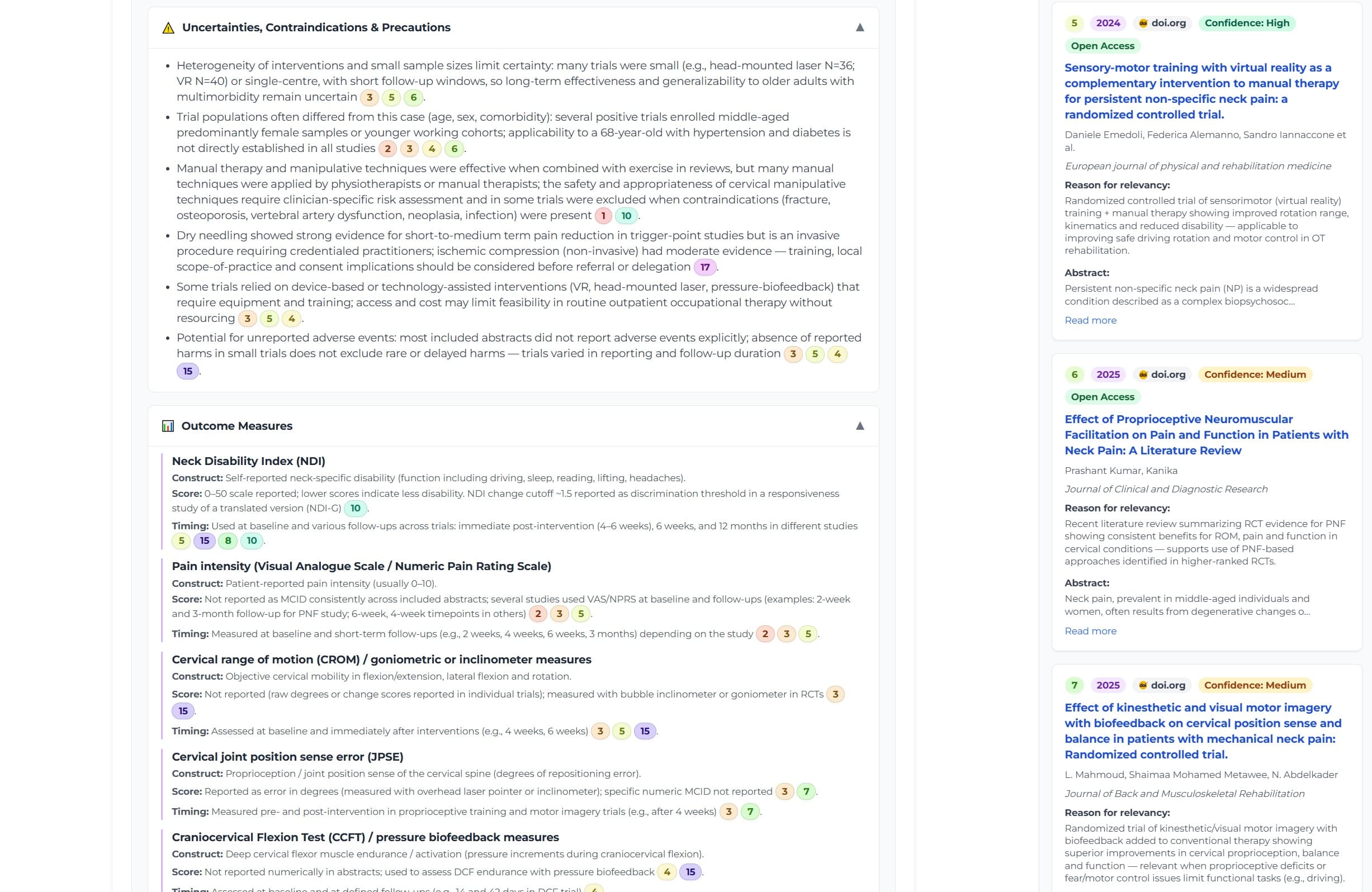
A workspace built for review, ranked evidence, and case use.
Traceable evidence signals, ranked sources, and structured outputs make it easier to inspect what the resource is built from before it is used in case work or supervision.
Use cases
Built for the points where manual research slows care.
Reducing manual literature review can support more efficient case planning, better use of supervision time, less non-billable research overhead, and more time for clinical care. Better informed decisions should help support stronger care quality and better client outcomes over time.
Customer Advisory Board
Join the practices helping shape SYMALA for Allied Health.
We are inviting a small set of forward-thinking clinics into the advisory process. Members receive grandfather pricing for life, priority access, and a direct line into product decisions.